
How Kakobuy notices expire, and how to tell which kind you are reading
Every promotion is a promise with a date attached, or without one. The way it runs out decides whether you can still count on it. Here are the six patterns we found in Kakobuy's own notices, plus one rule that changed with no notice at all.
Fixed end date: closes on a printed day

The simplest kind. The October 2026 flash sale runs on 15 and 16 October, GMT+8, and the notice adds one condition that matters: orders must be placed and paid during the event period. An order you place on the 16th and pay on the 17th falls outside it.
Fixed windows are honest but unforgiving. Two things trip people up. First, the clock is Beijing time; for a buyer in New York the window closes at noon on the 16th. Second, the payment that counts is the item payment. If your goods are not in your cart and paid by then, waiting for the warehouse does not help.
How to read one: find the end date, convert it to your own time zone, and check which payment it applies to. The coupon code and the referral program in the same notice also have fixed ends, 31 October, but each measures something different.
Fixed end with an afterlife: the value outlives the event

The shipping subsidy in the same notice has two dates. You earn it from 10 to 16 October: the product page shows the subsidy available, and it is credited when you pay for international shipping. Then a second line says shipping subsidies expire on 30 November 2026, six weeks after earning stops.
That gap is useful. You can buy during the week, let the goods reach the warehouse, wait for a late seller, and still ship at the subsidised rate in November. It is also confusing, because "the festival is over" and "my subsidy still works" are both true for a month and a half.
The June 2026 festival used the same pattern: earning from 9 to 15 June, expiry on 31 July. Read both dates every time; the second one is usually printed further down, after the "how it works" steps.
No end date, but withdrawable with notice

The EU notice of 2026-06-23 promises that Kakobuy will charge a flat €3 per parcel for the new category-based EU customs duty, however many categories the parcel holds. It has no end date. Near the bottom it adds: "If we are no longer able to continue this subsidy in the future, we will notify you separately in advance."
That sentence turns an open-ended promise into a conditional one. It also tells you exactly how it would end: a separate notice, published before the change. So the right way to rely on it is to check the announcement list for a newer EU notice before you submit a parcel. No newer notice in an archive is not proof of current eligibility: check the selected route and the actual parcel terms as well.
The notice also says Kakobuy "will make every effort to maintain this subsidy policy". That is effort, not a term. Treat it the same way.
No end date and no exit clause

Eight days after the €3 notice, Kakobuy published another: duty-free shipping lines continue for all EU destinations, include all applicable taxes and duties, and need no separate declaration or payment. No end date, no withdrawal sentence.
A notice without an end date has no printed expiry; that does not guarantee its terms still apply. A later notice, a changed line or an eligibility condition may change what applies to your shipment. Two older examples on the same list behave the same way: the US tax-free routes notice from April 2025 and the new-user coupon notice from September 2024. Both are still listed, both still read as current, and both are well over a year old.
The US one even promised a follow-up: "We will update the tax-free route information in the near future." Eighteen months later, no such update sits in the list. An open-ended notice is only as current as the date you last compared it with what the site actually does.
Quota only: ends when the stock runs out

Kakobuy's promote page offers a 100 yuan freight coupon with no minimum spend "with just 200 lucky winners", for newly registered users, redeemed under User Center, Wallet, Coupons, Exchange with the code printed in the banner. There is no start date, no end date and no counter.
A quota-only offer cannot be dated by anyone outside the company. It may have run out the week it was posted, or it may still be open. The fair way to treat it: try the code in the specified account screen and read any refusal message. Quota, account eligibility, a mistyped code or an already-redeemed offer may need different checks. Do not plan a purchase around it. Notice also that this page gives a different redemption path from the October festival notice (User Center, Coupons, Redeem); both may lead to the same screen, but you will only know by looking.
Undated leftover copy: a figure with no notice behind it

The home page card and the promote page badge both say new users get $105. No notice in the list says that. The current dated notice, from 2024-09-22, says ¥3000, about $410, and the registration page agrees with "Register to get ¥3000".
Where did $105 come from? An operator tutorial image, served from an upload folder dated 29 February 2024, shows the home page ticker of that time: "New users sign up and get $105 coupons!" So $105 looks like the sign-up figure from before September 2024, still painted on two pages two years later.
Undated copy never expires because it was never dated. The rule we use: a number only counts if a dated notice or the live checkout shows it. We cover the full sequence on the sign-up offers page.
The seventh case: a rule that changed with no notice
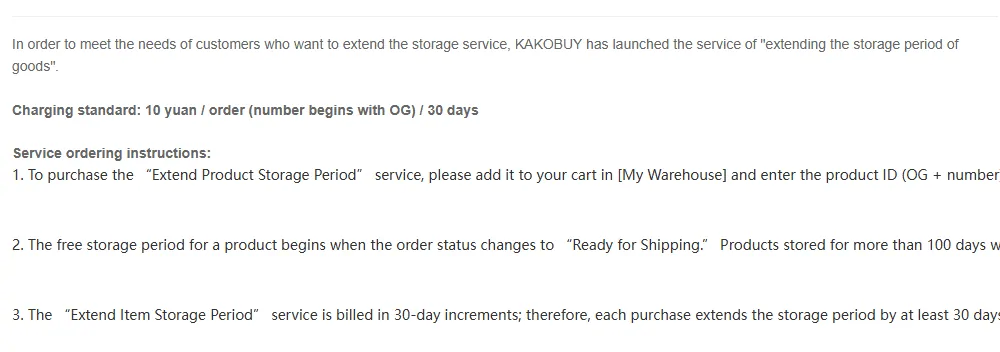
Not every change arrives as an announcement. The help article on extending warehouse storage read "20 yuan / order / 100 days" in a copy taken on 17 June 2026. On 10 October 2026 it read "10 yuan / order / 30 days", with a cooling-off period after free storage ends. No notice in the list mentions the change.
The same article says free storage begins when an item's status changes to "Ready for Shipping". The main storage article says the 100-day clock starts at "in storage". Both are current, both are undated, and they describe the start of the same clock differently. For planning, assume the earlier of the two.
Help articles carry no visible dates, so a reader cannot tell old text from new. We record the date we read each one on the fees and rules page, and log changes like this one on the updates page.
Your next check
Keep three dates beside a coupon
Write down when a code may be redeemed, when the resulting coupon expires and when your shipment will be paid. Do not assume those dates match. A quota-limited offer also requires availability at the moment it is claimed.
Eight-step ordering guide · Date checker
The deadline passes while payment is pending
A top-up receipt is not the same record as a paid commodity order. If a promotion requires an order to be placed and paid during its window, inspect that order’s payment status and recorded time. Keep the receipt and order number if the balance has been debited but the order still says unpaid; ask support to reconcile them before trying another payment.
The date checker only compares a date with the archived notice. It cannot confirm a delayed payment, account eligibility or whether the operator will accept an exception. Treat an unresolved result as an unresolved discount, rather than including it in your budget.